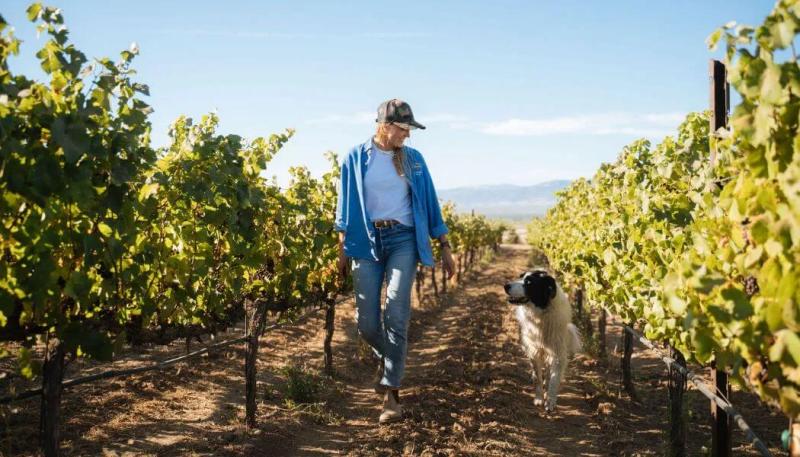
Land & Farming
Why Santa Lucia Highlands Wines Are So Balanced
5 min read
The Cool-climate difference
The Land Does the Work
Balance is the word that appears on every great tasting note: the quality that makes a wine feel complete rather than one-dimensional, rich without being heavy, structured without being severe. It sounds like a winemaker’s goal, but it is first a problem of geography. Ripeness and acidity run in opposite directions. As fruit sweetens on the vine, its natural acidity falls away. Most wine regions spend the growing season managing that trade-off. In the Santa Lucia Highlands, the land resolves it before the winemaker gets involved.
In the Santa Lucia Highlands (SLH), the calendar works for you. That is not a marketing line. It is a consequence of geography, and the reason why these wines taste the way they do.
A Corridor Built for Even Ripening
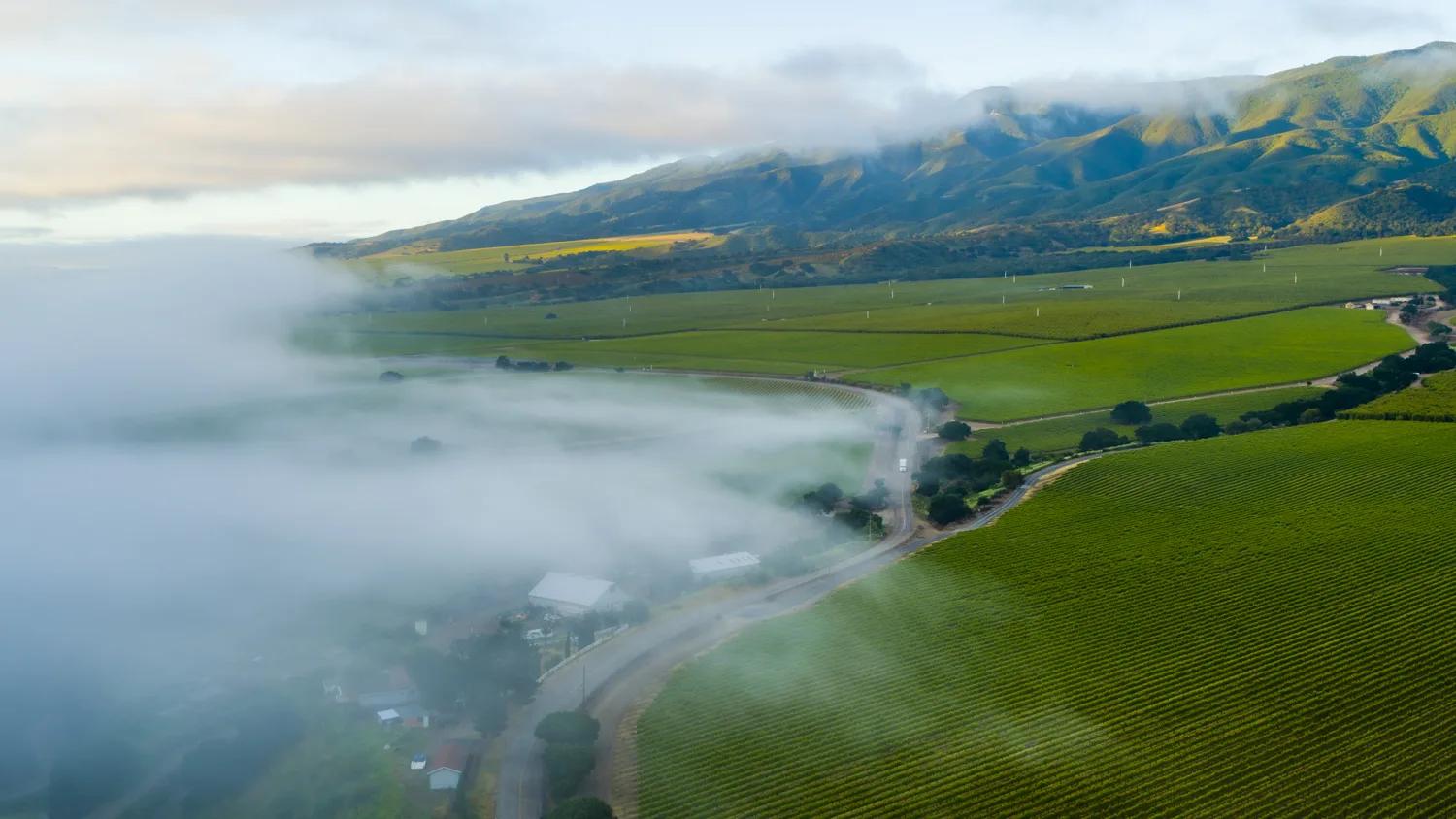
The Santa Lucia Highlands occupy east-facing terraces and elevated benches above the Salinas Valley floor, between 50 and 1,650 feet of elevation in Monterey County. The Salinas Valley runs north to south, oriented directly toward Monterey Bay, which acts as a funnel for cool marine air.
As the southern Salinas Valley heats each afternoon, a pressure differential pulls cool marine air down from Monterey Bay, a submarine canyon two miles deep and 60 miles long carrying 300 cubic miles of cold Pacific water close to shore. Winds arrive daily around 1 p.m., sustaining 10 to 15 miles per hour through the growing season with gusts to 25 or 30 mph. Fog follows at night, settling over the valley floor and lingering into the morning before the sun burns it off.
The result is a climate that is remarkably stable. And stability, for the vine – and especially for Pinot Noir – is everything.
“In the Santa Lucia Highlands, wind interrupts photosynthesis early each afternoon, slowing sugar accumulation, while the long, moderate season gives flavor ripening the time it needs.”


The 18-Degree Advantage
Viticulturist Mark Greenspan, Ph.D., of Advanced Viticulture, LLC, has documented the Santa Lucia Highlands and Monterey climate in detail alongside the world’s most respected cool-climate growing regions’ peers. His data on diurnal temperature variation during the ripening season tells the story precisely: the Santa Lucia Highlands records a day-to-night swing of just 18°F, the smallest of any cool-climate region studied on the West Coast. Russian River Valley swings 33°F. Santa Rita Hills swings 26°F. Santa Maria swings 25°F.
That compression matters because vine and fruit development are tightly linked to temperature. The SLH’s narrow, cool range means the vine operates in a consistent thermal environment day after day, week after week, from budbreak in February through a harvest that regularly runs into late October, one of the longest growing seasons in California, nearly up to six weeks longer than some other major Pinot Noir growing regions.
Two Processes, One Season
Berry ripening is two distinct and largely independent processes: sugar accumulation, which is driven by photosynthesis and temperature; and flavor ripening, which governs the development of tannins, anthocyanins, acids, and the flavor and aroma precursors that give wine its character and structure. Critically, flavor ripening is primarily time-dependent, and high temperatures can destroy the most fragile aroma molecules before they fully develop.
In warmer regions, the two processes race each other. Sugar accumulates faster than flavor compounds can develop; the winemaker either harvests early and accepts underripe phenolics or waits and accepts elevated alcohol. In the Santa Lucia Highlands, wind interrupts photosynthesis early each afternoon, slowing sugar accumulation, while the long, moderate season gives flavor ripening the time it needs. The outcome is grapes harvested at normal Brix levels of 24 to 25, with full phenolic ripeness, a combination that, in warmer appellations, is the exception, not the rule.
What the Soils Add
The climate does most of the work. The soils extend it. Granite-based alluvial deposits, gravelly and well-drained, with low natural fertility, stress the vines into producing small, concentrated berries with thick skins. Wind stress amplifies this further: daily mechanical pressure triggers the vine’s defense response, building cell wall density in the grape’s outer layers. More skin mass relative to juice means deeper color, firmer tannin structure, and richer phenolic complexity, at the same ripeness level where another appellation might give you a softer, less structured fruit.
At 13 inches of annual rainfall, a fraction of the Russian River (42 inches) or the Willamette Valley (39 inches), the SLH also benefits from an arid growing season with virtually no rain pressure at harvest. Vine stress is managed, not accidental. The conditions are demanding, and the fruit they produce is concentrated accordingly.
Rainfall Comparison: Top Pinot Noir regions
| Region | Annual Rainfall |
|---|---|
| Burgundy | 29 in. |
| Sonoma Coast | 40+ in. |
| Willamette Valley, Oregon | 39 in. |
| Russian River Valley | 42 in. |
| Santa Rita Hills | 13 in. |
| SANTA LUCIA HIGHLANDS | 10-14 in. |
What This Means in the Glass
Santa Lucia Highlands Pinot Noir is all about richness and silky texture alongside vibrant red fruit. Dark cherry and raspberry layered with earth, warm spice, and floral complexity, carried on the mouthwatering acidity that defines the appellation. The wines reach a level of ripeness that feels complete, even generous, without ever losing the freshness that makes them compelling from the first sip to the last. That combination of fullness and lift held in the same glass is what the long, even growing season makes possible, and what no amount of cellar work can manufacture.
For Chardonnay, the cool climate does what winemakers in warmer regions cannot achieve artificially. It lets them wait. Acids hold as flavors develop. The range runs from lean and citrus-driven at higher elevations to richly textured at lower ones, but the mineral core and natural acidity that give the wines their food-pairing range and aging potential persist across the spectrum.
Consistency is the final argument. Because the SLH records some of the smallest day-to-day temperature variability of any cool-climate appellation on the West Coast, with very little threat of rain or weather that could alter the direction of a growing season, the wines do not merely balance in a great vintage. They balance in every vintage, which means consistent, reliable quality from year to year.
The Winemaker’s Advantage
Balance built into the land is not passive. It is a working condition that experienced producers here have spent decades learning to read and amplify. The multi-generational farming families who anchor the region did not build their reputations by fighting their terroir. They built them by understanding it precisely enough to get out of the way.
For winemakers evaluating fruit sourcing, marketing teams building origin narratives, or buyers adding a cool-climate California anchor to a list, the Santa Lucia Highlands offers something genuinely hard to find: a region where the argument for balance is not a claim. It is a mechanism, documented in the data and expressed in the glass, vintage after vintage.